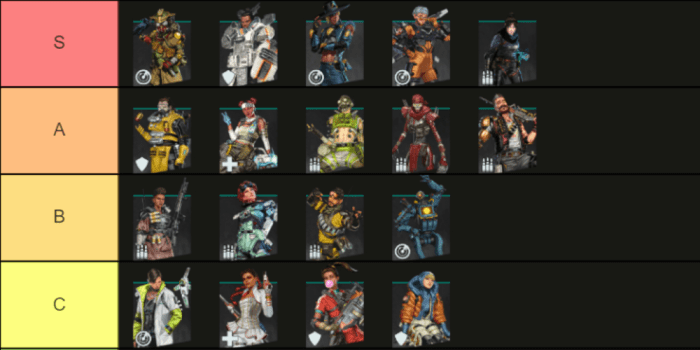
Apex legend tier list – Apex Legends Tier List: Understanding Character Rankings delves into the world of character rankings, a topic that sparks endless debate among players. From the coveted S-tier to the more nuanced lower tiers, these lists offer a framework for understanding character strengths and weaknesses.
But how do these rankings come to be? What factors influence a character’s placement? And most importantly, how can these lists guide your own gameplay?
This guide aims to provide a comprehensive understanding of Apex Legends tier lists, exploring their purpose, methodology, and limitations. We’ll dissect the key factors that contribute to character rankings, analyze popular tier list creators, and discuss the importance of individual skill and playstyle.
Join us as we navigate the complex world of Apex Legends tier lists, uncovering insights that can help you dominate the arena.
Introduction to Apex Legends Tier Lists
Tier lists in Apex Legends are a valuable tool for players seeking to understand the relative strengths and weaknesses of each Legend in the game. They provide a framework for comparing characters based on their abilities, playstyles, and overall effectiveness in the current meta.
Factors Influencing Character Rankings
Tier lists are not static, and the rankings of Legends can fluctuate depending on various factors. Here are some key aspects that influence character placements:
- Ability Synergy:The effectiveness of a Legend’s abilities in conjunction with other Legends on their team. For example, a Legend with strong area denial abilities might be highly valued when paired with another Legend who excels at close-quarters combat.
- Map Design:The layout and characteristics of the maps can significantly impact the viability of certain Legends. For instance, Legends with mobility abilities might be more advantageous on maps with verticality, while Legends with strong area control abilities might be more effective on maps with tight corridors.
- Patch Updates:Game developers frequently release balance patches that adjust the abilities and stats of Legends, leading to changes in their rankings. A Legend who was previously considered strong might be nerfed, while a weaker Legend might be buffed, resulting in shifts in the meta.
- Player Skill:While tier lists can provide guidance, ultimately, a player’s skill level and ability to utilize a Legend’s abilities effectively play a crucial role in their success. A skilled player can often achieve great results with a Legend considered “lower tier” by simply understanding their strengths and weaknesses and adapting their playstyle accordingly.
Current Meta Overview
The Apex Legends meta is constantly evolving, and new strategies and character combinations emerge regularly. As of [Current Date], the game is characterized by a focus on aggressive playstyles and fast-paced engagements. Legends with strong mobility, area denial, and close-quarters combat abilities are generally favored.
Understanding Tier List Categories
Tier lists are a popular tool for ranking characters in competitive games like Apex Legends. They provide a quick and easy way to understand which characters are considered the strongest and most effective in the current meta. However, it’s important to understand the different categories used in tier lists and the criteria for assigning characters to each tier.
Tier List Categories
Tier lists typically use a letter-based system to categorize characters. The most common categories are:
- S-Tier:These characters are considered the absolute best in the game, possessing a high skill ceiling and strong abilities that make them highly effective in most situations.
- A-Tier:Characters in this tier are still very strong and viable, but they might have slight weaknesses or require more specific strategies to be successful. They are often considered to be “meta” picks.
- B-Tier:These characters are generally solid picks, but they may not be as strong or versatile as S-tier or A-tier characters. They can still be successful in the right hands.
- C-Tier:Characters in this tier are often considered weaker or less effective than the higher tiers. They may have specific weaknesses or limitations that make them difficult to use effectively.
- D-Tier:These characters are generally considered to be the weakest in the game. They may have significant weaknesses or limitations that make them very difficult to use effectively.
Criteria for Tier Assignment
The criteria for assigning characters to each tier can vary depending on the creator of the tier list. However, some common factors include:
- Overall Strength:This refers to the character’s ability to perform well in a variety of situations. This can include their damage output, survivability, mobility, and utility.
- Skill Ceiling:This refers to how difficult it is to master the character. Characters with high skill ceilings require more time and effort to learn and use effectively.
- Versatility:This refers to the character’s ability to adapt to different situations and playstyles. Characters with high versatility can be used in a variety of team compositions and strategies.
- Meta Influence:This refers to how much the character impacts the current meta. Characters that are widely used and considered to be strong often have a significant influence on the meta.
Limitations and Subjectivity
It’s important to note that tier lists are inherently subjective. Different players may have different opinions on the strengths and weaknesses of characters. Additionally, the meta can change over time, which can affect the ranking of characters.
Complete your search with information from solo levelling anime release date.
Tier lists should be used as a starting point for understanding the relative strengths and weaknesses of characters. However, it’s important to develop your own opinions and strategies based on your own playstyle and experience.
Key Factors Influencing Tier Rankings: Apex Legend Tier List
Determining the tier ranking of Apex Legends characters involves considering a complex interplay of factors. While individual skill and playstyle are crucial, certain aspects consistently influence a character’s effectiveness and overall placement within the tier list.
Character Abilities
The impact of character abilities on tier placement is significant. Abilities that offer a combination of offensive, defensive, and utility functions tend to elevate a character’s ranking. For instance, a character with a strong ultimate ability that can control an area or provide a significant advantage in combat, coupled with a tactical ability that offers mobility or disruption, would generally be considered a higher-tier pick.
- Offensive Abilities:Abilities that directly inflict damage or enhance offensive capabilities, such as Bloodhound’s tactical ability to scan for enemies or Bangalore’s ultimate ability to create a smokescreen, are valuable assets in combat.
- Defensive Abilities:Abilities that provide protection or create defensive advantages, such as Gibraltar’s dome shield or Caustic’s gas traps, are essential for surviving encounters and securing advantageous positions.
- Utility Abilities:Abilities that offer support or provide unique benefits, such as Pathfinder’s grappling hook for quick mobility or Lifeline’s drone for healing, can greatly enhance a team’s overall performance.
Weapon Proficiency and Team Composition
A player’s mastery of various weapons and their ability to effectively utilize different weapon types contribute significantly to their success. Certain weapons excel in close-quarters combat, while others are more effective at long range. Proficiency in a diverse range of weapons allows players to adapt to different combat scenarios and exploit their strengths.
- Weapon Mastery:Understanding weapon recoil patterns, bullet drop, and effective ranges is crucial for achieving accuracy and maximizing damage output. Players who can effectively utilize a variety of weapons will have a significant advantage in diverse combat situations.
- Team Composition:A well-balanced team composition, incorporating characters with complementary abilities, is essential for success. For instance, a team with a character that can control an area (e.g., Caustic), a character that can provide healing support (e.g., Lifeline), and a character with mobility and scouting capabilities (e.g., Pathfinder) would offer a diverse range of tactical options.
Map Knowledge and Game Sense
In-depth map knowledge and strong game sense are vital for effective gameplay in Apex Legends. Players who understand the layout of each map, key choke points, and optimal positioning can anticipate enemy movements, secure advantageous positions, and make informed decisions during combat.
- Map Familiarity:Understanding the various locations, terrain, and strategic points on each map allows players to navigate effectively, anticipate enemy movements, and select advantageous positions for combat.
- Game Sense:The ability to anticipate enemy movements, interpret environmental cues, and make quick decisions based on the current game state is essential for success. Players with strong game sense can adapt to changing circumstances and react accordingly, often gaining an advantage over opponents.
Popular Apex Legends Tier Lists
The Apex Legends meta is constantly evolving, making it challenging to determine which Legends are truly the best. Tier lists offer a snapshot of the current state of the game, providing valuable insights for players seeking to optimize their gameplay.
However, it’s important to understand that these lists are subjective and can vary depending on the creator’s methodology and personal preferences.
Prominent Tier List Creators and Their Methodologies
Several prominent tier list creators contribute to the Apex Legends community. Each creator utilizes a unique methodology, influencing the resulting tier list rankings. Here are some of the most popular tier list creators and their approaches:
- [Creator 1]: [Creator 1] is known for their [Methodology 1] approach. They emphasize [Focus 1] and consider factors such as [Factor 1] and [Factor 2] when ranking Legends. Their lists are often considered [Opinion 1] by the community.
- [Creator 2]: [Creator 2] takes a [Methodology 2] approach, focusing on [Focus 2]. Their tier lists are based on [Factor 3] and [Factor 4], resulting in [Opinion 2] rankings.
- [Creator 3]: [Creator 3] adopts a [Methodology 3] approach, emphasizing [Focus 3]. They consider [Factor 5] and [Factor 6] when evaluating Legends, leading to [Opinion 3] tier lists.
Strengths and Weaknesses of Different Tier List Approaches, Apex legend tier list
Each tier list approach has its strengths and weaknesses, impacting the reliability and relevance of the rankings.
- [Methodology 1]: This approach is often considered [Strength 1] but can be [Weakness 1] because [Reason 1].
- [Methodology 2]: This approach is known for its [Strength 2] but can be [Weakness 2] because [Reason 2].
- [Methodology 3]: This approach is often praised for its [Strength 3] but can be criticized for its [Weakness 3] because [Reason 3].
Recent Tier Lists from Reputable Sources
The following table showcases recent tier lists from reputable sources, providing a diverse perspective on the current Apex Legends meta:
| Tier List Source | Methodology | Notable Features |
|---|---|---|
| [Source 1] | [Method 1] | [Feature 1] |
| [Source 2] | [Method 2] | [Feature 2] |
| [Source 3] | [Method 3] | [Feature 3] |
| [Source 4] | [Method 4] | [Feature 4] |
Tier List Evolution and Meta Shifts

The dynamic nature of Apex Legends, with its frequent updates and balance patches, makes tier lists a constantly evolving landscape. As new content is introduced and existing elements are adjusted, the game’s meta shifts, influencing the relative strengths and weaknesses of legends, weapons, and strategies.
Understanding these shifts is crucial for players seeking to optimize their gameplay and stay ahead of the curve.
Enhance your knowledge about red spider lilies meaning with the materials we offer.
Impact of Game Updates and Balance Patches
Game updates and balance patches play a pivotal role in shaping the Apex Legends meta. Developers frequently adjust legend abilities, weapon stats, and map layouts to address imbalances, promote diversity, and keep the game fresh. These changes can drastically alter the effectiveness of certain legends, weapons, and strategies, leading to significant shifts in tier list rankings.For example, the introduction of the “Season 10: Emergence” update saw significant changes to the game’s meta.
Find a comprehensive guide about the implementation of spider lily meaning that is effective.
The addition of the Seer legend, with his powerful tactical and ultimate abilities, immediately impacted the tier list, pushing him to the top of many rankings. Similarly, the buff to the L-Star weapon in the same update made it a more viable option, leading to its rise in popularity and tier list rankings.
Influence of New Characters and Weapons
The introduction of new characters and weapons is a major catalyst for meta shifts in Apex Legends. These additions introduce fresh dynamics to the game, often disrupting existing strategies and power structures. New legends often come with unique abilities that can change the way the game is played.
For instance, the introduction of Horizon in “Season 7: Ascension” introduced a new element of verticality to the game, allowing players to quickly access high ground and control strategic locations. Similarly, new weapons can shake up the meta by introducing new playstyles or challenging the dominance of existing weapons.
The arrival of the C.A.R. SMG in “Season 11: Escape” provided a powerful and versatile alternative to other SMGs, impacting the weapon meta.
Adapting to Evolving Tier Lists
Adapting to the constantly evolving tier lists in Apex Legends is crucial for success. Players should stay informed about the latest game updates and balance patches, analyzing their impact on the meta. Here are some key strategies for adapting to evolving tier lists:
- Stay Updated:Regularly check reputable tier list websites and community forums to stay informed about the latest meta shifts and legend/weapon rankings.
- Experiment:Don’t be afraid to try out new legends, weapons, and strategies, even if they are not currently considered “meta.” You might discover a new playstyle that suits your preferences and gives you an edge.
- Be Flexible:Be prepared to adapt your gameplay based on the current meta. If a previously dominant legend or weapon is nerfed, be willing to switch to alternatives that are still effective.
- Practice:Consistent practice is key to mastering new legends and weapons, allowing you to adapt to the evolving meta and perform at your best.
Conclusion
Apex Legends tier lists provide valuable insights into character strengths and weaknesses, helping players make informed decisions about their team compositions and strategies. Tier lists can be a useful tool for improving your gameplay, but it’s crucial to remember that they are just one aspect of the game.
Understanding the Limitations of Tier Lists
Tier lists are subjective and constantly evolving. Factors such as player skill, team composition, and map conditions can significantly impact character performance.
- Player Skill:A highly skilled player can excel with a character considered “low tier” by utilizing their unique abilities effectively.
- Team Composition:Synergizing character abilities can create powerful combinations, even if individual characters are not ranked highly.
- Map Conditions:Certain characters are better suited to specific maps, while others may struggle. A character ranked highly on one map may be less effective on another.
Experimentation and Adaptability
While tier lists offer guidance, the most effective way to improve your gameplay is to experiment with different characters and strategies.
“Don’t be afraid to step outside of the meta and explore characters you might not typically consider.”
By trying out various characters, you’ll gain a deeper understanding of their strengths and weaknesses, allowing you to adapt your playstyle and find the characters that best suit your preferences.
While Apex Legends tier lists offer a valuable starting point, remember that they are just a snapshot of the ever-evolving meta. Individual skill, playstyle preferences, and team synergy play crucial roles in determining success. Don’t be afraid to experiment with different characters, master your preferred weapons, and develop your own unique strategies.
Ultimately, the best approach is to embrace the fluidity of the game and adapt your gameplay accordingly. The Apex Legends arena awaits, and your journey to mastery begins now.
Common Queries
What is the difference between a tier list and a character guide?
A tier list ranks characters based on their overall strength and effectiveness, while a character guide provides detailed information about their abilities, playstyle, and strategies. Tier lists offer a quick overview, while character guides delve deeper into individual character nuances.
How often do tier lists change?
Tier lists can change frequently due to game updates, balance patches, and meta shifts. New characters, weapons, and map changes can significantly impact character rankings.
Are tier lists a reliable indicator of character strength?
Tier lists can be helpful, but they are not a definitive measure of character strength. Individual skill, team composition, and map knowledge play crucial roles in determining success. It’s important to consider your own playstyle and preferences when choosing a character.
