Hashira Rank, the pinnacle of power within the Demon Slayer Corps, signifies a level of strength and dedication unmatched by any other. These elite warriors, each specializing in a unique Breathing Technique, stand as the last line of defense against the relentless onslaught of demons.
Their selection is rigorous, demanding not only exceptional swordsmanship but also unwavering resolve and a deep understanding of the demon threat. To become a Hashira is to shoulder the immense responsibility of protecting humanity and leading the fight against Muzan Kibutsuji, the ultimate evil.
The Hashira are more than just skilled swordsmen; they are the embodiment of courage, resilience, and unwavering commitment to their mission. Their unique abilities, honed through years of relentless training, enable them to face even the most formidable demons.
From the graceful movements of the Water Hashira to the thunderous force of the Sound Hashira, each Hashira possesses a distinct fighting style, each as formidable as the next.
Hashira Powers and Abilities

The Hashira, also known as the Pillars, are the nine most powerful swordsmen in the Demon Slayer Corps, each specializing in a unique Breathing Technique. Their abilities are a testament to their dedication, training, and natural talent, making them formidable opponents against demons.
This section will delve into the unique Breathing Techniques, strengths, weaknesses, and mastery of swordsmanship exhibited by each Hashira.
Breathing Techniques
The Hashira’s Breathing Techniques are derived from ancient swordsmanship techniques and enhanced with the power of the Sun Breathing. These techniques allow the Hashira to utilize their physical abilities to their full potential, granting them superhuman strength, speed, and agility.
Each Hashira has a unique Breathing Technique that reflects their personality and fighting style.
- Water Breathing: The Water Breathing technique, mastered by Giyu Tomioka, is a versatile and adaptable style. It emphasizes fluidity and adaptability, mirroring the constant movement of water. Water Breathing utilizes flowing, continuous movements to counter the demon’s attacks. Giyu’s Water Breathing is known for its powerful attacks, such as “Water Surface Slash,” which can cleave through multiple demons with a single strike.
Deepen your understanding with the strategies and methods of smoker one piece live action.
- Flame Breathing: Kyojuro Rengoku, the Flame Hashira, is renowned for his aggressive and passionate fighting style. Flame Breathing techniques are characterized by explosive, fiery movements that overwhelm opponents with their sheer force. Rengoku’s Flame Breathing is known for its powerful attacks, such as “Blazing Dance,” which can create a torrent of flames that engulf the enemy.
- Sound Breathing: Tengen Uzui, the Sound Hashira, is a master of stealth and deception. His Sound Breathing techniques are designed to confuse and disorient opponents, allowing him to strike with precision and speed. Uzui’s Sound Breathing is known for its ability to create sonic booms, such as “Clanging Sound,” which can stun and disorient demons.
- Love Breathing: Mitsuri Kanroji, the Love Hashira, is a powerful and compassionate fighter. Her Love Breathing techniques are designed to protect her allies and defeat demons with love and compassion. Kanroji’s Love Breathing is known for its ability to generate powerful blows, such as “Love Whirlwind,” which can create a vortex of love that overwhelms demons.
- Stone Breathing: Gyomei Himejima, the Stone Hashira, is a physically imposing Hashira whose strength and durability are unparalleled. His Stone Breathing techniques are designed to withstand powerful attacks and deliver devastating blows. Himejima’s Stone Breathing is known for its ability to generate immense force, such as “Stone Fortress,” which can create an impenetrable barrier.
- Wind Breathing: Sanemi Shinazugawa, the Wind Hashira, is a fierce and relentless fighter. His Wind Breathing techniques are characterized by swift and powerful attacks that cut through the air like a windstorm. Shinazugawa’s Wind Breathing is known for its ability to generate high-speed attacks, such as “Whirlwind Slash,” which can create a whirlwind of blades.
- Insect Breathing: Shinobu Kocho, the Insect Hashira, is a skilled and cunning fighter. Her Insect Breathing techniques are designed to paralyze and weaken opponents with poison. Kocho’s Insect Breathing is known for its ability to deliver precise and deadly attacks, such as “Poisonous Butterfly,” which can inject a potent poison into the demon’s body.
- Mist Breathing: Muichiro Tokito, the Mist Hashira, is a mysterious and elusive fighter. His Mist Breathing techniques are designed to confuse and disorient opponents, allowing him to strike from unexpected angles. Tokito’s Mist Breathing is known for its ability to create illusions and disappear into thin air, such as “Mist Phantom,” which can create a copy of himself to confuse the demon.
- Thunder Breathing: Zenitsu Agatsuma, the Thunder Hashira, is a skilled swordsman who is often underestimated due to his cowardly nature. His Thunder Breathing techniques are characterized by lightning-fast attacks that can overwhelm even the strongest demons. Agatsuma’s Thunder Breathing is known for its powerful attacks, such as “Thunderclap and Flash,” which can create a shockwave that stuns the demon.
Strengths and Weaknesses
Each Hashira’s fighting style has its own strengths and weaknesses, which are influenced by their Breathing Techniques and personal fighting strategies.
- Strengths: The Hashira’s strengths are primarily derived from their Breathing Techniques. They possess superhuman speed, strength, and agility, allowing them to effectively combat demons. Their mastery of swordsmanship, coupled with their Breathing Techniques, allows them to deliver devastating blows.
- Weaknesses: Despite their immense power, the Hashira are not invincible. They can be vulnerable to attacks that exploit their weaknesses, such as their reliance on their Breathing Techniques. Some Hashira may also have weaknesses that are related to their personality or fighting style.
Mastery of Swordsmanship
The Hashira are highly skilled swordsmen who have dedicated their lives to mastering the art of swordsmanship. Their mastery of swordsmanship is evident in their precise movements, powerful strikes, and ability to predict their opponent’s movements. They are able to utilize their swords with incredible speed and accuracy, delivering deadly blows with ease.
- Swordsmanship Techniques: The Hashira utilize various swordsmanship techniques, such as the “Total Concentration Breathing” and the “Hinokami Kagura,” which allow them to maximize their physical abilities and enhance their swordsmanship.
- Swordsmanship Skills: In addition to their swordsmanship techniques, the Hashira possess a range of skills that enhance their combat prowess. These skills include:
- Precision: The Hashira can strike with incredible accuracy, targeting specific points on their opponent’s body.
- Speed: The Hashira can move at incredible speeds, allowing them to dodge attacks and strike with lightning-fast reflexes.
- Agility: The Hashira are incredibly agile, allowing them to move with ease and change direction quickly.
- Strength: The Hashira possess immense physical strength, allowing them to deliver powerful blows.
- Endurance: The Hashira can withstand significant damage and continue fighting despite injuries.
Hashira Relationships and Dynamics
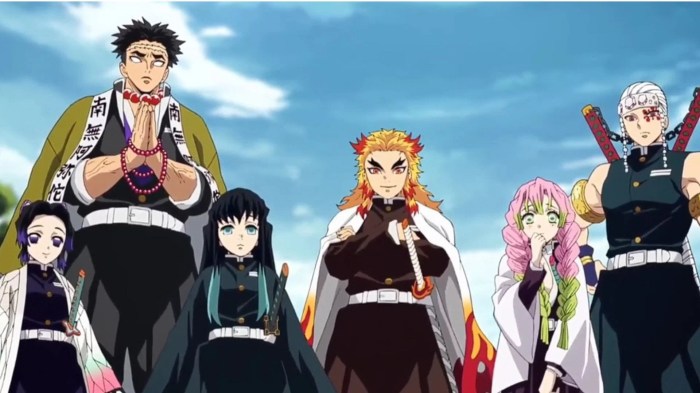
The Hashira, the elite swordsmanship corps of the Demon Slayer Corps, are a tightly knit group bound by their shared purpose and the dangers they face. Their relationships are complex, shaped by their personalities, experiences, and the pressures of their duty.
The Hashira’s Impact on Leadership and Decision-Making
The Hashira’s personalities significantly influence their leadership styles and decision-making processes. Each Hashira brings a unique perspective and approach to their role, contributing to the overall dynamic of the group. For example, the stoic and unwavering Giyu Tomioka, the Water Hashira, prioritizes discipline and efficiency in his leadership, while the flamboyant and charismatic Rengoku Kyojuro, the Flame Hashira, emphasizes camaraderie and encouragement.
This diverse range of personalities allows the Hashira to approach challenges from multiple angles, fostering adaptability and innovation in their strategies.
Evolution of Relationships
The relationships between the Hashira evolve over time, shaped by shared experiences and the challenges they face together. Early in the narrative, the Hashira are shown to be somewhat distant and formal in their interactions. However, as they face increasingly dangerous threats and confront their own personal struggles, they begin to develop deeper bonds of trust and camaraderie.
For example, the relationship between Tanjiro Kamado and the Hashira, particularly Giyu Tomioka, develops from initial distrust to mutual respect and understanding as Tanjiro proves his strength and dedication.
Do not forget click gojo satoru death to obtain more thorough aspects of the gojo satoru death topic.
Hashira Impact on the Story: Hashira Rank
The Hashira, the elite swordsmen of the Demon Slayer Corps, play a pivotal role in shaping the narrative of Demon Slayer. Their strength, experience, and unwavering dedication to their cause directly influence the course of events, driving the story forward and ultimately leading to the downfall of Muzan Kibutsuji.
Hashira Influence on Key Battles
The Hashira’s impact on the story is most evident in their involvement in key battles against powerful demons. Their presence often turns the tide of battle, showcasing their immense power and strategic prowess.
- The Battle of Natagumo Mountain: The Hashira’s intervention in the Natagumo Mountain arc is crucial. The combined strength of the Hashira, led by Giyu Tomioka, successfully repels the demon spider family, saving Tanjiro and his companions. This battle highlights the Hashira’s ability to work together as a team, effectively utilizing their unique skills to overcome a formidable foe.
- The Battle Against the Upper Ranks: The Hashira’s encounters with the Upper Ranks, Muzan Kibutsuji’s most powerful lieutenants, demonstrate the immense power and resilience required to fight these formidable demons. The Hashira, particularly Rengoku Kyojuro, are instrumental in pushing back against the Upper Ranks, showcasing their individual prowess and their unwavering dedication to protecting humanity.
The Hashira’s sacrifice and their determination to protect others inspire the younger generation of Demon Slayers, like Tanjiro, to persevere and fight for a better future.
- The Final Battle Against Muzan: In the final battle against Muzan, the Hashira play a crucial role in weakening him and buying time for Tanjiro and Nezuko to land the final blow. Their combined strength and strategic thinking are essential in achieving this goal, highlighting their importance in the overall narrative arc.
Hashira Impact on Character Development
The Hashira’s influence extends beyond battles, impacting the character development of other key figures in the story, particularly Tanjiro Kamado.
You can feel the advantages of reviewing when does new cod come out today.
- Rengoku Kyojuro: Rengoku’s mentorship of Tanjiro is a significant turning point in Tanjiro’s journey. Rengoku’s unwavering dedication to his duty and his genuine compassion for others inspire Tanjiro to strive for greatness and to always protect those he cares about.
Rengoku’s sacrifice also serves as a catalyst for Tanjiro’s growth, pushing him to become stronger and more determined to defeat Muzan.
- Giyu Tomioka: Giyu’s initial harshness and aloof demeanor are gradually softened by Tanjiro’s unwavering spirit and determination. This interaction between the two characters showcases the importance of empathy and understanding in overcoming prejudice and challenging one’s own beliefs. Giyu’s mentorship, though often subtle, helps Tanjiro to develop his own unique style of fighting and to understand the true meaning of being a Demon Slayer.
Hashira Contribution to the Fight Against Muzan Kibutsuji
The Hashira’s contributions to the fight against Muzan Kibutsuji are immeasurable. Their strength, experience, and unwavering dedication to their cause are essential in weakening him and ultimately defeating him.
- Strategic Planning: The Hashira’s strategic planning and coordination are crucial in effectively combating Muzan. Their ability to analyze his strengths and weaknesses, and to strategize accordingly, is vital in overcoming his immense power.
- Providing Support: The Hashira’s presence provides vital support to Tanjiro and Nezuko in their final battle against Muzan. Their combined strength and strategic thinking are essential in achieving this goal, highlighting their importance in the overall narrative arc.
- Sacrifice and Dedication: The Hashira’s sacrifice and unwavering dedication to their cause are a testament to their strength and resolve. They inspire the younger generation of Demon Slayers, like Tanjiro, to persevere and fight for a better future.
Hashira Symbolism and Themes

The Hashira, the elite swordsmanship masters of the Demon Slayer Corps, embody more than just exceptional fighting prowess. They represent a complex tapestry of symbolism and themes that weave through the narrative of Demon Slayer, enriching its meaning and impact.
The Symbolism of Power and Responsibility
The Hashira stand as a physical manifestation of power, the pinnacle of swordsmanship in the Demon Slayer Corps. Their strength and skills are unmatched, enabling them to confront the most formidable demons. This representation of power, however, extends beyond physical strength.
It encompasses their unwavering commitment to protecting humanity, their unwavering dedication to their duty, and their resilience in the face of overwhelming odds. They are the guardians of humanity, a symbol of hope in a world ravaged by demons. The Hashira’s power is not just about physical prowess, but about the responsibility they shoulder to protect the weak and fight for a brighter future.
The Theme of Sacrifice, Hashira rank
The Hashira’s lives are marked by sacrifice. They dedicate their lives to fighting demons, often at great personal cost. Their training is arduous, pushing them to their limits, and their battles are fraught with danger. Many Hashira lose their lives in the line of duty, their sacrifices a testament to their unwavering commitment to their mission.
Their willingness to lay down their lives for the greater good highlights the theme of selflessness and the profound impact of sacrifice on the narrative.
The Hashira’s Role in Developing Key Themes
The Hashira play a crucial role in developing key themes throughout the narrative. Their dedication to their duty and unwavering commitment to protecting humanity provide a strong counterpoint to the darkness and despair that pervades the world of Demon Slayer.
Their struggles against demons, their sacrifices, and their unwavering belief in humanity serve to highlight the themes of resilience, hope, and the enduring power of human spirit. Their relationships with other characters, particularly the protagonist Tanjiro Kamado, provide a framework for exploring themes of loyalty, camaraderie, and the importance of finding strength in one another.
The Hashira are not merely powerful individuals; they are the heart and soul of the Demon Slayer Corps. Their unwavering determination, their unwavering commitment to protecting humanity, and their unwavering spirit of self-sacrifice inspire those around them, pushing them to overcome their limitations and face the seemingly insurmountable.
Through their strength, their wisdom, and their unwavering dedication, the Hashira play a pivotal role in shaping the narrative of the Demon Slayer story, ultimately leading the fight against the forces of darkness.
Top FAQs
How many Hashira are there at any given time?
There are typically nine Hashira, representing the nine different Breathing Techniques.
What are the requirements to become a Hashira?
Becoming a Hashira requires exceptional swordsmanship, a deep understanding of demon lore, and unwavering dedication to the Demon Slayer Corps. Candidates must also demonstrate mastery of a Breathing Technique and possess a strong sense of responsibility and leadership.
Can a Hashira be replaced?
Yes, if a Hashira is killed or incapacitated, a new Hashira can be chosen to fill their position.
